Projects
About Me
Find Me
Portfolio
All Posts:
- Tomasulo's algorithm
- Ham Radio: 9:4:1 Impedance Matching with a Homemade Autotransformer
- RISC Processor in Logisim, Custom ISA, and compiler
- Newspaper Article: Competing in Science Olympiad
- Newspaper Article: Hosting a Learn to Solder Day at LASA Electronics Club
- Animated LED map of territorial expansion in the modern day German region + Road trip!
- Another Blog Post About This Blog (updates!)
- Updates and Future of the Blog
- MathMl: Easy Embedded Math in HTML (No extra libraries, browser supported!)
- Raymarching: Perfect Spheres and Easy 3D
- Never Write a Line of CSS Again
- Jinja is Awesome
- A Blog Post About This Blog
Newspaper Article: Competing in Science Olympiad
2026-2-28
This is a non-technical article about Science Olympiad which I wrote for my local neighborhood newspaper.
I joined my school’s Science Olympiad team at the start of this school year with some friends of mine and have been having a good time with it. Science Olympiad is an academic competition where schools send teams of 15 people to competitions to compete in 23 different events, such as Entomology, Chemistry, and Astronomy. You can have a partner for each event while competing, and each member of a team usually focuses on studying for 2-4 events throughout the year.
There are three major types of events: build, test, and identification. Although I’m not competing in any build events, my favorite build event is Helicopter. The goal of the Helicopter event is to make a helicopter that can stay in the air for as long as possible, only powered by a rubber band. These typically require a lot of trial and error to design, and I’ve been told that the year we made it to nationals, the person doing the helicopter event was making their own rubber bands to maximize the energy they could store in them. The other type of event, a test, is simply just a test over your event topic that you take with your partner. Sometimes there is also a lab component to these tests where you have to do something hands-on. The third type of event is identification, where you are shown images and need to identify what they are. The main identification events are Entomology (identifying insects) and Rocks and Minerals (identifying rocks).
To prepare for the events, there are rules about what can appear on the tests for each event, so you can research the categories listed out through any means you would like. I enjoy studying by going really deep into Wikipedia articles by clicking just about every link on them and also by reading textbooks. I do know some people who will just watch a lot of YouTube videos on their topics and do really well, so you can really just do whatever works for you. Our team hosts official practices two days a week where you can study with your partner and take practice tests with them if you wish to do so.
The events I’m competing in are Astronomy, Circuit Lab, and Remote Sensing. This year, all of the Astronomy tests have a heavy focus on stellar evolution, so I have had to research and learn a lot about how stars are born, their life cycles, and their deaths. Circuit lab focuses on analyzing circuits and has a lab component where you typically are given components and have to find unknown component values by building small circuits and measuring voltage or timing things. I actually joined Science Olympiad for the Circuit Lab event, as I am very interested in electronics and wanted an excuse to learn more about them. My last major event is Remote Sensing, which is about getting information about the earth from satellites in orbit. This includes, for example, all of the weather satellites, any satellite taking photos of the earth, satellites tracking mass shifts in the earth, and so on. I’ve had to learn a lot about atmospheric modeling and different methods of sensing (optics, RADAR, LIDAR, gravitational, etc.) for this event.
About half of the competitions we do are online, but we do get to travel for the major ones. The most notable competitions I’ve gone to were hosted at MIT in Cambridge, Massachusetts, and Stanford near San Francisco. I didn’t do too well at the MIT competition as it was my second in-person event, and I had been a bit thrown off by the lab portion on the circuit lab test, but I was able to get 3rd in Circuit Lab out of about 60 teams later at the Stanford competition. These two competitions were back-to-back weekends, so I ended up missing two Fridays from traveling on the plane with the team and had to find time to catch up on everything.
If you are interested in competing in Science Olympiad, most Austin-area high schools have a team, and you just need to ask to join near the start of the school year. I don’t know how other schools do it, but at LASA we have more than 30 people, and there can only be 15 per team, so we hold “test-offs” where you compete with other people at LASA to make it onto either an A or a B team. Our A team goes to all of the travel competitions, while the B team does more online ones, but both teams do travel for State (which is in April at Texas A&M). Overall, Science Olympiad is a really good way to get really in-depth into some areas you may not have otherwise (like Astronomy and Remote Sensing for me) or a good way to get in depth into an area you like a lot (like Circuit Lab for me). I would recommend it to anyone who enjoys learning on their own and at their own pace.
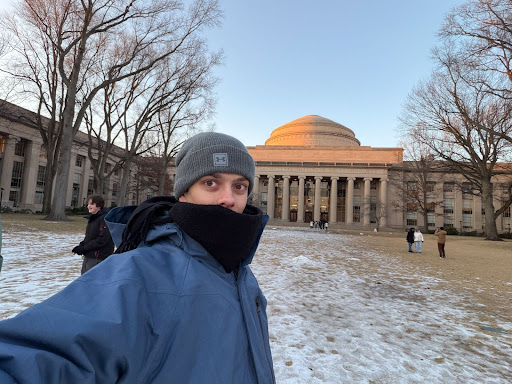 Dome at MIT
|
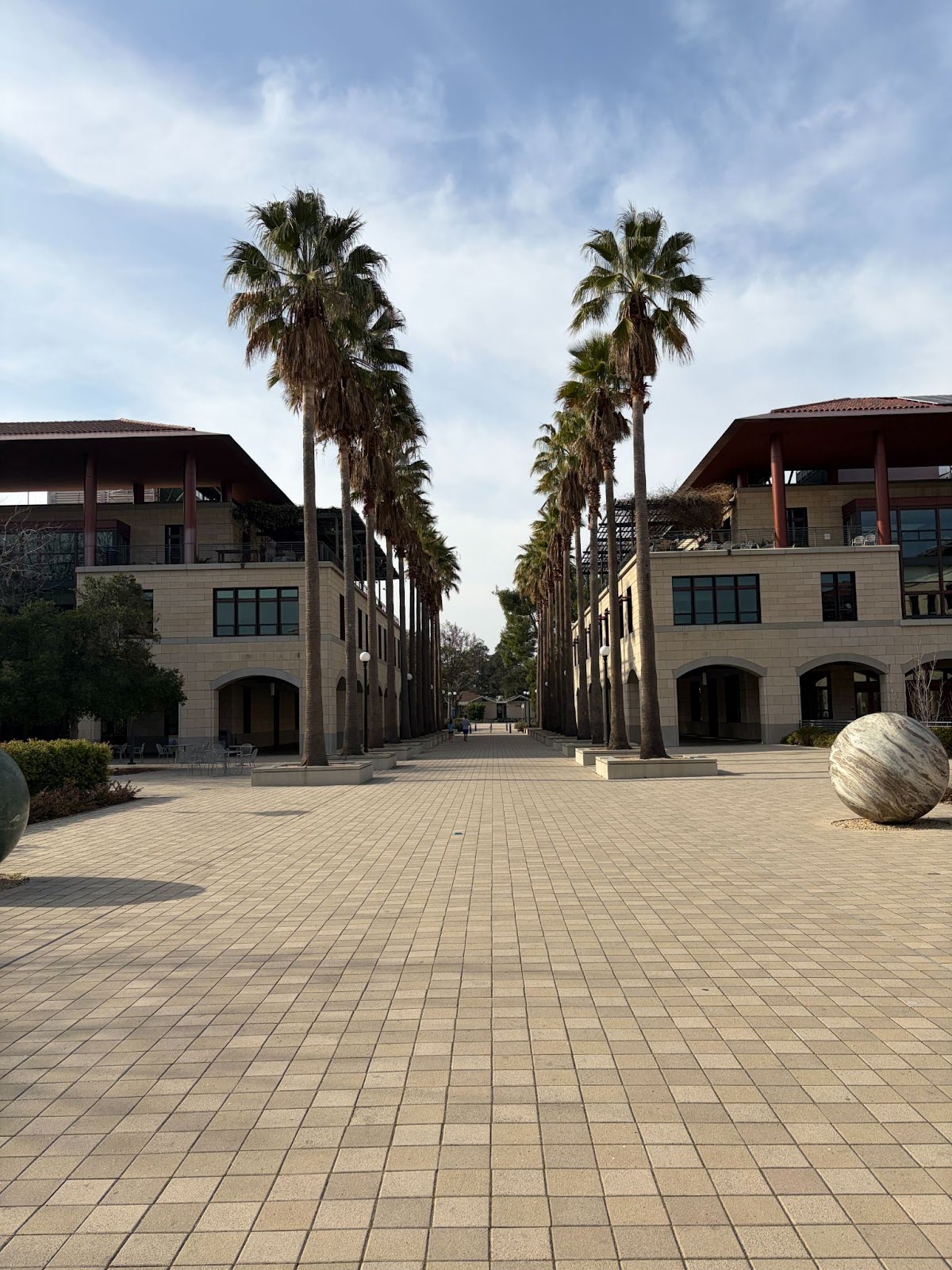 Palm trees at Stanford (awesome campus!!)
|
Ham radio at MIT
This was a brief side-segment to the article as I have written about ham radio in the past for the newspaper
The competition at MIT happened to overlap with the nationwide Winter Field Day amateur radio competition, where you try to speak with as many people as you can over the air. I packed a very small station with my G90 radio, a battery, and an antenna in my backpack and was able to set up and talk to people around the country in between my events. It was far below freezing, so I didn’t end up operating for too long, but it was still a good time.
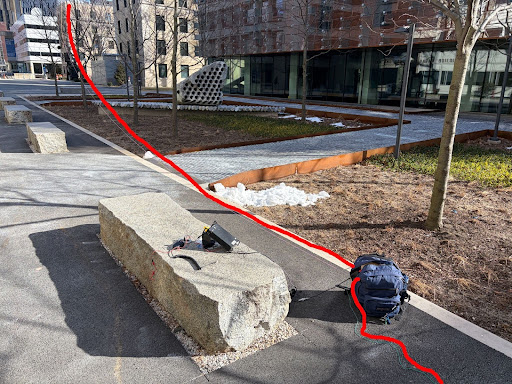 Radio setup at MIT. Antenna wire highlighted in red. I believe it was a 35.5' and 6.5' random wire antenna using an autotransformer with taps for 9:1 and 4:1 impedance matching.
Comments
Post a comment:
Please don't spam the comments, I get a notification every time. Also please be mature (Nolan)
Message limit: 1500 characters, name limit: 100 characters
No comments here yet. You should write one!